Korea aluminum extrusions suit buyers who need tight tolerances, automotive or battery grade quality systems, and suppliers already running to Hyundai, Kia, LG and Samsung program discipline. Korea has no primary smelting, so metal cost tracks the LME plus an import premium. The decision turns on specification difficulty, program volume, and tariff exposure rather than price per kilogram.
This guide covers the supplier base, die terms, commercial mechanics, and trade exposure. For the wider sector picture, start with the overview of Korea’s aluminum industry.
Data current as of September 2026.
Why Source Aluminum Extrusions from Korea?
Korea earns a place on the shortlist when the profile is hard to make. It holds no bauxite reserves and no primary smelter capacity, appearing in neither of those tables in the U.S. Geological Survey’s Mineral Commodity Summaries 2026, so Korean extruders buy billet at the global reference price everyone else pays, and the advantage sits in conversion: press capability, die engineering, surface treatment, machining, and quality systems built supplying Korean automotive and electronics customers.
Buyers pay for that. South Korea’s aluminum exports to the United States reached 1.24 billion USD in 2025 (UN COMTRADE via Trading Economics, 2026). Korea loses on commodity architectural profile at volume and wins on structural automotive profiles, EV battery enclosures, precision profiles, and anything the extruder has to co-engineer. Where a profile feeds a battery pack, the wider picture sits in the guide to aluminum in Korea’s EV and battery supply chain.
Who Are Korea’s Aluminum Extruders?
The base splits into an architectural tier and a mobility tier built around automotive and battery programs. Aluko Group is the largest extrusion house, producing roughly 100,000 tonnes a year and ranking first domestically on capacity (Hankyung, 2022). Its 601.4 million USD battery module case frame contract with BlueOval SK, announced in March 2024 for 2026 to 2030 (Al Circle, 2024), has lapsed. Ford and SK On agreed in December 2025 to dissolve the joint venture, with SK On taking the Tennessee plant (Supply Chain Dive, 2025), and Dealsite reported on February 13, 2026 that the project had effectively fallen through, quoting an Aluko official on disagreement over production scale. Aluko has turned that Tennessee capacity to non-battery industrial extrusion, with overseas EV battery revenue pushed past 2028.
ALMAC Co., Ltd. is a KOSDAQ listed extruder in Changwon making EV battery module cases and platform components; its 2025 investment in AR Aluminum supports a 9,000 metric ton press at Sacheon reported as South Korea’s largest (SMM, May 2025). HAI Materials Korea, a Hammerer Aluminium Industries and LS Cable joint venture, opened a Gumi plant in May 2025 running a 60 meganewton line, roughly 6,100 metric tons of force (Aluminium Today, May 2025).
Shinyang Metal extrudes curtain wall and window sections plus automotive parts including EV battery cases. Namsun Aluminum makes windows, curtain wall, and industrial structural profile, with an automotive division producing bumpers and interior parts. SeAH Aerospace & Defense supplies aerospace sections.
What Can Korean Extruders Actually Make?
The envelope is set by container bore, press tonnage, die capability, and finishing. Alloy coverage centers on the 6000 series: 6063 for architectural profile, 6061 and 6082 for structural sections, 6005A where extrudability and strength both matter, with 7000 series from fewer producers. Flat rolled work runs on a different alloy and temper map, covered in the guide to sourcing sheet and coil from Korean mills.
Write the temper next to the alloy every time. EN 515 (2017) defines the designations: T5 is cooled from an elevated temperature shaping process and artificially aged, T6 is solution heat treated and artificially aged, and T66 reaches a level higher than T6 through special control of the process. EN 755-2 (2016) sets the property values for each temper on extruded profiles. 6063-T5 and 6063-T6 are separate products at separate prices, and T6 depends on the press quench being fast enough, so quench type (air, water spray, water bath) is a press selection question for the request for quotation.
Container bore sets the maximum circumscribing circle a press can produce, and tonnage and extrusion ratio decide whether the section can be pushed at that diameter. A wide, thin profile can be refused by a press with generous tonnage and a small container, so ask for container diameter alongside tonnage.
Mills produce to KS D 6759 and cross-reference ASTM B221, EN 755-9, or JIS H 4100, with mill test certificates on chemistry and dimensions. EN 12020-2 (2022) covers extruded precision profiles in EN AW-6060 and EN AW-6063 only, so calling it up on a 6082 section is itself a specification error. EN 755-9 (2016) governs dimensional tolerance for other 6000 and 7000 series sections.
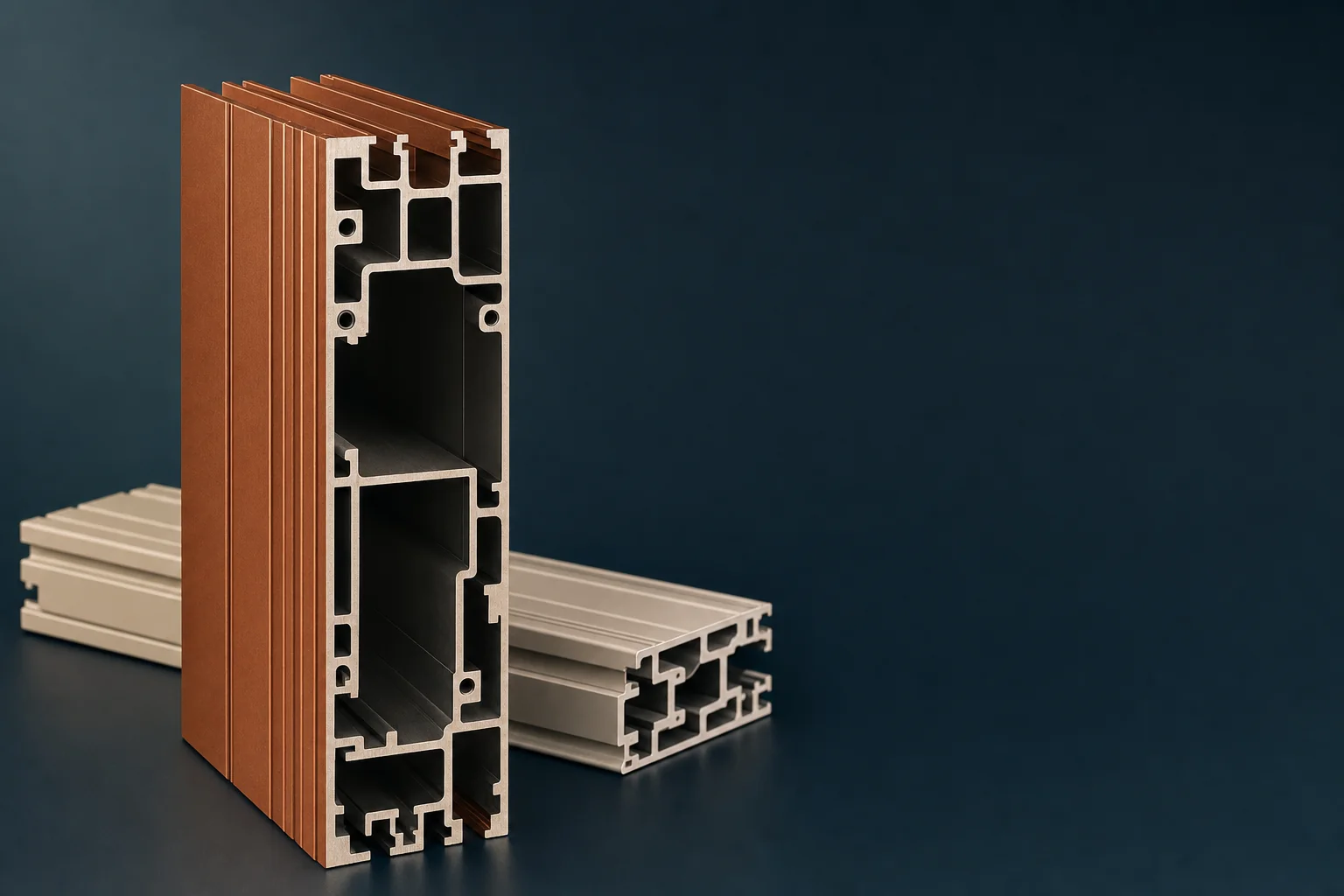
Anodizing, powder coating, thermal break assembly, and CNC machining are available in country. Two anodizing terms belong in the specification. Anodic coating adds thickness on each surface and consumes dimensional tolerance, and EN 12020-2 tolerances apply to profiles supplied without further surface treatment, so state whether the tolerance class governs before or after anodize. Colour and gloss consistency between lots is the common architectural dispute, which the Qualanod specification (2026) settles against reference samples agreed by both parties, so hold approved panels.
How Do You Qualify a Korean Extrusion Supplier?
Qualification runs through the die. You agree the drawing and tolerance class, the extruder cuts the die, you run a trial, you measure first articles, then discuss serial production. Budget for at least one correction cycle on any thin-walled, asymmetric, or tightly twisted profile.
Put a calendar against it. These ranges are operator judgment, not published data: die manufacture three to six weeks from a frozen drawing, first trial and samples two to three weeks more, each correction cycle two to four weeks, and first serial shipment eight to sixteen weeks from order, against four to twelve weeks for standard Korean aluminum products.
Die terms decide whether you can move the program later. Paying for a die does not by itself buy a second source. Settle three items separately in writing: legal ownership, the conditions for physical release, and whether any die design data transfers. Korean extruders commonly keep the die in their own shop, carry out nitriding and correction, and decline to release the design, because bearing lengths, porthole and bridge geometry, and feeder design are their process intellectual property. Fix die life too, normally expressed in extruded tons or pushes before replacement, and name who pays for the replacement and whether die cost is a one-time charge, an amortization, or piece-price bundled.
Automotive and battery programs carry a second approval track: the extruder’s quality system approves the process under IATF 16949 while your customer’s program qualification approves the part. That mirrors supplier approval across Korea’s semiconductor industry, and the sequencing drives the calendar. Audits are normal; press floor, die shop, and quality records are customarily open, while process parameter sheets and die design files stay with the extruder. Inquivix Technologies publishes an aluminum extrusion supplier selection checklist covering technical evaluation criteria.
What Do Commercial Terms Look Like?
Korean extrusion pricing separates metal from conversion. Conversion is a per kilogram charge varying with profile complexity, wall thickness, alloy, temper, and quantity, with finishing and packaging quoted separately. A single all-in number with no stated metal basis is impossible to index when the LME moves.
Name the metal mechanism in the request for quotation: which LME quotation the metal fixes against, cash settlement or three month, the regional premium and its published reference, the quotation period, the fixation date, how long the metal leg stays valid, and whether you may fix forward. Ask separately for the billet upcharge over ingot, because an extruder buys billet rather than P1020 and that adder is negotiated per tonne, varying with alloy and billet diameter.
Quotes usually arrive marked FOB Busan or Incheon in USD. Under Incoterms 2020 (International Chamber of Commerce, 2019), FOB covers goods delivered on board a vessel, so containerized extrusion handed over at a terminal should be quoted FCA, which closes the risk transfer gap. Freight here is volumetric, because extrusions are long and low in density, so agree cut length, bundling, and end protection alongside the price.
First orders usually settle by telegraphic transfer deposit or sight letter of credit. Below a mill’s practical minimum, a trading house is the route, and the guide to finding a business partner in Korea applies.
What Tariff and Trade Exposure Comes with Korean Extrusions?
Trade policy is the largest single variable in the landed cost of Korean extrusions into the United States. The Aluminum Extruders Coalition and the United Steelworkers filed petitions in October 2023 covering fifteen origins including South Korea, and the Dominican Republic case ended after the preliminary phase, which is why the final phase ran on fourteen (Sidley, 2023; USITC, October 2024). Commerce set a top Korean dumping margin of 3.13 percent on September 27, 2024, with ALMAC at zero (Al Circle, October 2024). On October 30, 2024 the International Trade Commission found no injury or threat, so no orders issued and deposits were refunded (USITC, October 2024).
That outcome is under challenge. The petitioners sued at the U.S. Court of International Trade in December 2024, docketed as Court No. 25-00001 in January 2025, challenging the Commission’s injury analysis (International Trade Today, 2025). No decision reversing it has been publicly reported as of September 2026. A different case, Court No. 23-00270 on the Dominican Republic, was decided: Slip Op. 25-44 of April 18, 2025 sustained the Commission’s negligibility finding there (U.S. Court of International Trade, 2025). That opinion has no bearing on Korea. An agreement signed while the appeal runs therefore needs a duty reinstatement clause naming who bears retroactive duty if the determination is reversed and orders issue.
Section 232 covers HTSUS chapter 76, where extruded profiles classify. Since April 6, 2026 the rate is 50 percent on aluminum articles and 25 percent on derivative articles, assessed on full customs value rather than declared metal content (C.H. Robinson, April 2026). A capped 15 percent rate runs through December 31, 2027 on metal-intensive industrial and electrical grid equipment derivatives, reverting to 25 percent after. The proclamation of June 1, 2026, effective June 8, widened that band to agricultural equipment and certain residential HVAC, added an Annex I-C temporary rate structure, lowered the US-origin metal threshold from 95 to 85 percent, and pulled aluminum lithographic plates into derivative coverage. Eligibility runs mainly by product, with one exception in Korea’s favor: mobile industrial equipment reaches 15 percent only from trade deal partner countries, and South Korea is on that list (C.H. Robinson, June 2026; GHY International, 2026). None of this moves the 50 percent headline rate on chapter 76 extrusions.
Because Korea smelts nothing, every Korean extrusion carries a foreign primary country of smelt, the largest landed cost risk in this lane. Under U.S. Customs and Border Protection guidance effective June 28, 2025, importers report the primary country of smelt, the secondary country of smelt, and the country of most recent cast. Reporting unknown requires filing under HTS 9903.85.67 or 9903.85.68 and draws the 200 percent Section 232 duty applied to Russian aluminum (GHY International, 2025; CBP CSMS guidance, 2025). Demand all three declarations with mill documentation for the billet, and make them a purchase order condition. A supplier who cannot document billet origin defaults you to 200 percent.
The arrangement announced by the United States and Korea in November 2025 left the 50 percent metals rate in place (CSIS, 2025), and KORUS does not exempt aluminum from Section 232. European buyers face the EU Carbon Border Adjustment Mechanism, in its definitive phase since January 1, 2026 (International Carbon Action Partnership, 2026). Classification stays a commercial variable, because the gap between an article and a derivative is 50 versus 25 percent, and finishing in Korea can change which one you import.
Where Does Korean Extrusion Sourcing Go Wrong?
Most failed programs treat extrusion as a commodity purchase: benchmark price per kilogram against a Chinese quotation, skip die terms, then discover the real cost after the first correction cycle.
The specific failures are these. Smelt and cast origin goes undocumented, the entry declares unknown, and the 200 percent Russia rate lands on a shipment priced against a 50 percent assumption. Temper goes unstated and T5 arrives against a drawing that assumed T6. Tolerance class goes unstated, so the mill quotes to KS general tolerance while the drawing assumes EN 12020-2 precision and first articles fail. And specifications sit in English while shop floor documentation sits in Korean, a gap worth closing before the die is cut. See also the guide to doing business in Korea.
Frequently Asked Questions
Are Korean aluminum extrusions subject to US antidumping duties?
No orders are in force. Commerce set a top Korean margin of 3.13 percent in September 2024, and the U.S. International Trade Commission returned a negative injury determination on October 30, 2024, terminating the cases with deposits refunded (USITC, October 2024). Petitioners sued at the Court of International Trade in December 2024, and no decision reversing that determination has been publicly reported, so contracts need a duty reinstatement clause.
What alloys, tempers, and tolerances can Korean extruders hold?
Coverage centers on 6063, 6061, 6082, and 6005A, with 7000 series from a narrower group including the aerospace suppliers. State temper with the alloy, because 6063-T5 and 6063-T6 differ in price and in press quench requirement. EN 515 (2017) defines the tempers and EN 755-2 (2016) sets their property values. Mills produce to KS D 6759 and cross-reference ASTM B221, EN 755-9, or JIS H 4100. EN 12020-2 precision tolerances cover 6060 and 6063 only.
What is the minimum order quantity for Korean extrusions?
Minimums follow the die and the press rather than published policy, so they differ by producer and profile. Ask separately for the minimum per die per run and the minimum per shipment. Buyers below a mill’s practical minimum generally work through a trading house or distributor consolidating orders across Korean sources.
Taking the Next Step
Korea’s extrusion base rewards difficult profiles and punishes price shopping. Match the specification to the right press and container, agree die, temper, and tolerance terms before tooling is cut, and document smelt origin.
Industrial sourcing, including extrusions, coil, and sheet in specific alloys, is handled by Inquivix Technologies. To discuss a Korean extrusion requirement, contact joon@joonklee.com or the contact page.